A prompt engineering course teaches you how to give clear instructions to AI tools — so they actually do what you want, first time. If you've ever typed something into ChatGPT and got back a response that completely missed the point, this is the skill that fixes that. And it turns out it's not that hard to learn.
What Is Prompt Engineering, and Why Does It Matter?
Prompt engineering sounds technical. It isn't.
It simply means knowing how to phrase what you ask an AI — so the AI understands your actual intent, not a rough approximation of it.
Think of it like this: if you asked a very capable but literal-minded assistant to "write something about my business," you'd get something generic and probably useless. But if you said "write a 3-sentence Instagram caption for my bakery that focuses on our sourdough and ends with a question to encourage comments," you'd get something you could actually use.
That second version is a prompt. The skill of writing prompts like that — consistently, across different tasks and tools — is prompt engineering.
It matters now because AI is being built into almost every piece of software people use for work. Google Search. Microsoft Word. Email clients. Customer service tools. The quality of what you get from all of them is increasingly determined by how well you can communicate with AI.
Who Should Take a Prompt Engineering Course?
The short answer: anyone who uses a computer for work.
More specifically, a prompt engineering course is worth your time if you are:
- Job hunting or changing careers — AI literacy is appearing on job descriptions across industries. Knowing how to use AI tools effectively — and being able to say so — is a practical advantage in interviews.
- Already working and feeling behind — if colleagues seem to be getting more done with AI tools and you're not sure how, prompt engineering is the gap.
- A student — the ability to use AI for research, writing, and problem-solving is becoming as expected as knowing how to use a search engine.
- Running a small business — prompt engineering lets you use AI tools for marketing copy, customer responses, planning, and admin without hiring anyone to do it for you.
You do not need a technical background. Prompt engineering is about communication, not coding.
What a Good Prompt Engineering Course Actually Covers
Not all courses are worth your time. A beginner-friendly course should cover these things without assuming you already know them:
The basics of how AI models work — not the mathematics, but the practical behaviour. Why AI gives confident-sounding wrong answers. Why context matters. Why the same question phrased differently produces completely different results.
Prompt structure — how to add role, context, goal, and constraints to get better outputs. This is the core skill and should take up the bulk of the course.
Real tasks — writing, summarising, researching, planning, formatting. You should leave with prompts you've actually used, not theoretical examples.
AI agents — the next step beyond chatbots. Agents that can browse the web, run automations, and complete multi-step tasks. Understanding how to direct them is where prompt engineering is heading.
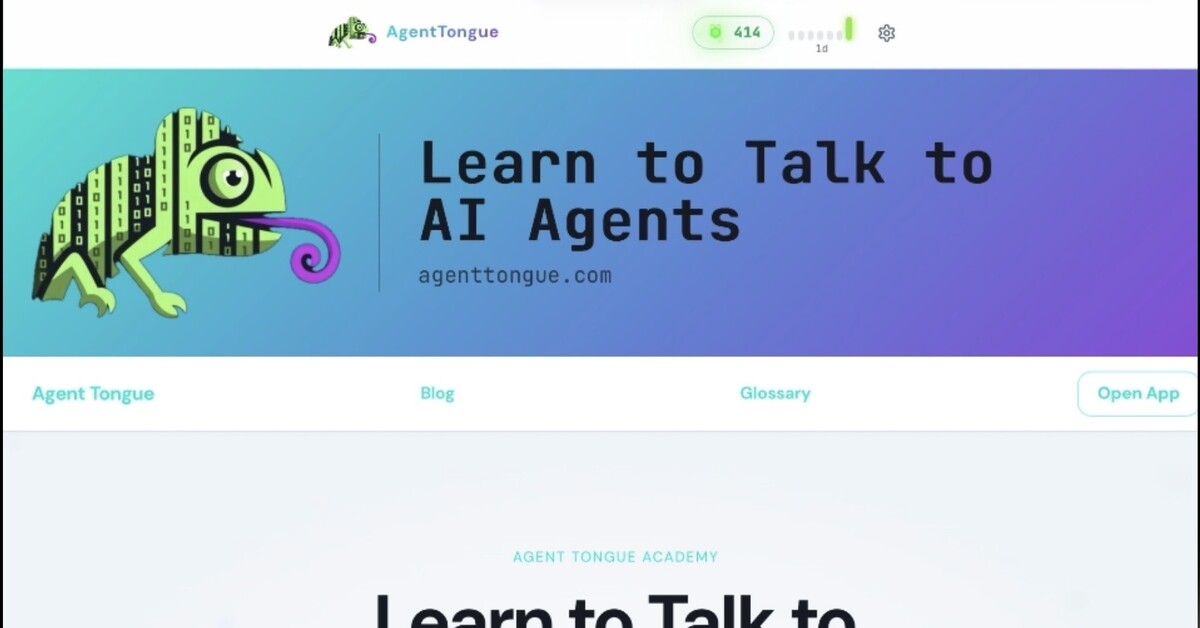
AgentTongue covers all of this across 8 units, starting from zero. It's built for people with no technical background who want to build a real skill, not just read about one.
The AgentTongue Approach: Learning by Doing
Most courses explain prompt engineering. AgentTongue makes you practise it.
The platform uses a gamified format — pixel art characters, collectible agent cards, and unit completion milestones — to make the learning stick. Each lesson gives you a real task to complete with a prompt, and you get feedback on how well your prompt performed.
The reason this matters: reading about prompting and being able to do it under pressure are two different things. Someone who has written 200 prompts across varied tasks will outperform someone who watched 10 hours of tutorial video, every time.
AgentTongue is structured into 8 units covering everything from writing your first prompt to directing AI agents on multi-step tasks. There's a free tier with 2 lessons per day — no card required — so you can see whether it suits how you learn before committing anything.
What to Look for in Any Prompt Engineering Course
If you're comparing options, here's a short checklist:
- Does it teach structure, or just give you a list of example prompts to copy?
- Does it include AI agents, or stop at chatbots?
- Is it built for beginners, or does it assume coding knowledge?
- Can you try it before paying?
- Is the content kept up to date as AI tools evolve?
A course that gives you a framework for writing prompts will serve you better than one that gives you 50 templates. Templates go out of date. The underlying skill doesn't.
Taking the First Step
The gap between people who can use AI effectively and people who can't is widening quickly. It's not a gap in intelligence or technical ability — it's a gap in a specific, learnable skill.
A prompt engineering course is how you close it.
Start for free at AgentTongue.com — no card needed, 2 lessons per day on us.